Changing Course
Share this blog
Latest Maritime Vacancies
Crewing Superintendent (CSOV) – Cyprus
Head of Cyber Security | Cyprus/Remote
Marine Operations Superintendent – LNG – Qatar
Senior Sales Manager – Europe
Marine Insurance Account Executive – New Business – UK
Gender Pay Gap in Maritime
- Apr 22, 2026
- Reading Time: 7 mins
- Daryna Rozum

Gender pay inequality began to be addressed legally in the 1970s with equal pay laws, but the modern concept of the “gender pay gap” and systematic efforts to measure and reduce it only emerged in the last few decades. Mandatory reporting was introduced in the UK in 2017 and more recently by the EU through the Pay Transparency Directive that obliges members to build a comprehensive legal framework for companies to report their gender pay gap.
Understanding Gender Pay Gap
What is gender pay gap? It is often confused with equal pay, however the two are fundamentally different. Equal pay considers the pay difference between men and women who carry out the same or similar jobs or conduct work of equal value. It is unlawful in the UK and EU to pay a man or a woman differently to do exactly the same job. Gender pay gap, in its turn, is the difference in earnings between women and men across the workforce. It derives from horizontal and vertical segregation. Horizontal segregation means that women and men are concentrated in different sectors or jobs, with women overrepresented in fields that pay relatively lower wages, and underrepresented in higher-paid fields. Vertical segregation means that more men are present in higher levels of seniority than women[1].
In the UK, it is calculated as the percentage difference between mean or median earnings of men and women, calculated relative to men’s earnings.
The UK Gender Reporting
The UK is widely seen as a pioneer of modern gender pay gap reporting, introducing one of the first large-scale and standardised reporting frameworks. It is a good example of obligatory reporting narrowing the gender pay gap faster: between 2010 and 2017, the overall UK gender pay gap reduced by 2.1%. Comparing 2017 (when mandatory reporting was introduced) to 2025, the national mean gender pay gap lowered by 3.8% which indicates a faster pace of a change.
EU Gender Pay Transparency Directive
In 2021, European Commission published a proposal for a Directive of the European Parliament and of the Council to strengthen the application of the principle of equal pay for equal work between men and women. In the proposal, they highlighted that failure to close gender pay gap affects women’s economic independence during their working life and thereafter. This is also a problem for the efficient operation of the labour market creating a clear risk of loss of productivity in the economy at large due to suboptimal female labour market participation[2].
This proposal was later followed by the 2023 Directive that outlined reporting on pay gap between female and male employees. Only employers with 100 workers or more will have to report their gender pay gap calculations, with a deadline of 7th June 2027[3].
According to Financial Times, between 2014 to 2024 (the latest data available) the gender pay gap shrunk in 31 of 36 OECD countries. The median country with mandatory reporting reduced its gap by 25%, compared with 17% for those without reporting policy implemented[4].
Mandatory Reporting – Is It Effective?
The graphs below show the change in gender pay gap after mandatory reporting was introduced. Comparison starts at 5 years before the introduction and 5 years after.
The gender pay gap is narrowing faster in countries where reporting is mandatory (mean gender pay gap, %, 5 years before the mandatory reporting adoption and 5 years after)
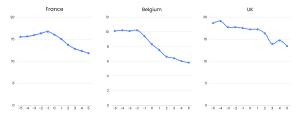
Source: Gender pay gap in unadjusted form[5], Gender pay gap[6]
As we can observe, the gender pay gap narrowing in the above countries sped up in the 5 years after adoption of mandatory gender pay gap reporting. The variation in pace arises because countries are starting from different points in terms of gender norms, social roles and economic structure.
The gender pay gap is less linear in countries without mandatory government-issued gender pay gap reporting (mean gender pay gap (except USA), %, 10 years’ perspective)
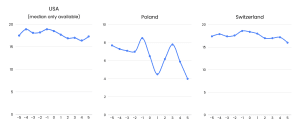
Source: Gender pay gap[7], Highlights of women’s earnings in 2024[8]
US gender pay gap calculations are typically based on median earnings, whereas European ‘unadjusted’ gender pay gap statistics are usually based on mean earnings, making them methodologically different. However, median measures still clearly track the direction of the gender pay gap – the US, together with Poland and Switzerland among others, are the countries with no legislative requirements to report gender pay gap at the government level. Although some other regulations are in place, for example employers in Switzerland with 100 or more employees are required to share their gender pay gap with employees and shareholders, progress in closing the gender pay gap is less linear.
Examples represented above speak in favour of transparency and gender pay gap reporting on national level. Individual sectors can, of course, differ, subject to existing historical and societal circumstances.
Gender Pay Gap in Maritime
Spinnaker used data collected as a part of shore-based salary survey to assess and compare maritime sector in the UK (over 2,200 UK shore-based positions) to the national UK figures.

Source: Spinnaker
It comes as no surprise that the maritime sector has higher gender pay gap than the overall national figure. In our previous reports we mentioned how women are most commonly found in lower-paid maritime jobs, as well as in the most junior positions. However, despite initially higher gender pay gap, compared to 2020, in 2025 it decreased by 4.84%, showing that the industry is taking steps towards supporting women’s progression to higher-paid and more senior roles.
To aid gender pay gap reporting, Spinnaker is using UK government methodology in producing bespoke reports for our members. Now, in the wake of the EU pay transparency deadline coming up with still unclear details of how the reporting will be translated into national law, we are happy to provide tailored help using individual company’s data.
Why Gender Pay Gap Matters
It is important for companies to understand their gender pay gap because it contributes to the following:
It increases salary transparency. Once aware of the existing gender pay gap, organisations can amend and communicate their pay structures more efficiently. This reduces speculation, builds trust and helps ensure compliance with increasing regulatory expectations around pay disclosure.
It ensures staff retention. Identifying and addressing gender pay gap strengthens employee trust and reduces staff turnover.
It boosts economic efficiency. Wider pay gaps can generally signify deeper structural inefficiencies, such as unequal progression opportunities or underutilisation of talent. Addressing these issues improves how effectively an organisation allocates and develops its workforce. In turn, this can enhance productivity and overall performance.
It enhances reputation. In a landscape where Gender Pay Transparency factors matter, demonstrating commitment to pay equity strengthens credibility, particularly among candidates who prioritise fairness and inclusion.
To request your personalised gender pay gap bespoke report, please contact [email protected]
[1] OECD (2023), Reporting Gender Pay Gaps in OECD Countries: Guidance for Pay Transparency Implementation, Monitoring and Reform, OECD Publishing, Paris, https://doi.org/10.1787/ea13aa68-en
[2] European Commission. Proposal for a Directive of the European Parliament and of the Council (Brussels: European Commission, 2021), 000427d6-9d07-4710-800a-58885025e41e_en
[3] Official Journal of the European Union. Directive (EU) 2023/970 of the European Parliament and of the Council (of 10 May 2023). Available at: https://eur-lex.europa.eu/legal-content/EN/TXT/PDF/?uri=CELEX%3A32023L0970
[4] Murray, C (2026). After years of pay gap reporting, what do we know? Financial Times. Available at: After years of pay gap reporting, what do we know?
[5] Gender pay gap in unadjusted form. Eurostat. Available at: [tesem180] Gender pay gap in unadjusted form
[6] Gender pay gap. Office for National Statistics. Available at: Gender pay gap – Office for National Statistics
[7] Gender pay gap in unadjusted form. Eurostat. Available at: [tesem180] Gender pay gap in unadjusted form
[8] Highlights of women’s earnings in 2024. U.S. Bureau of Labor and Statistics. Available at: https://www.bls.gov/opub/reports/womens-earnings/2024/home.htm