Changing Course
Share this blog
Latest Maritime Vacancies
Crewing Superintendent (CSOV) – Cyprus
Head of Cyber Security | Cyprus/Remote
Marine Operations Superintendent – LNG – Qatar
Senior Sales Manager – Europe
Marine Insurance Account Executive – New Business – UK
Seafarer training moves beyond the classroom
- Jul 15, 2025
- Reading Time: 4 mins
- Jennifer Harrison
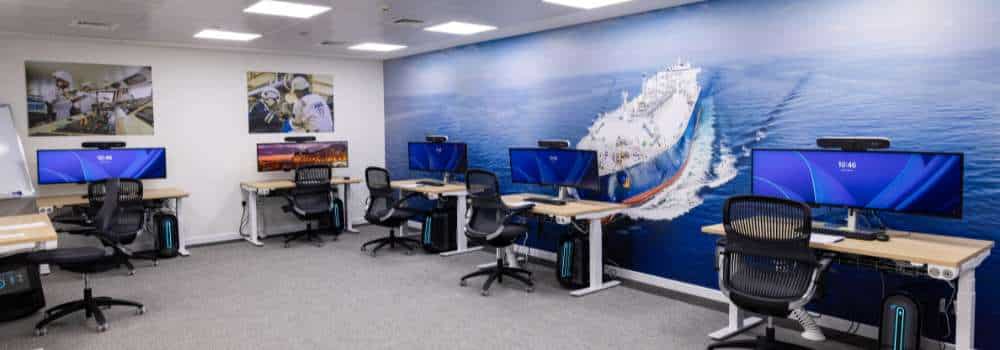
New approaches are needed to train and upskill seafarers to face the maritime industry’s challenges, writes Jennifer Harrison, VP, ABS Training Solutions
Decarbonization and digitalisation present a decades-long challenge to the shipping industry and there is a growing realisation that their impact will be felt most keenly by the people who crew the global fleet.
The industry is already looking to seafarers to adopt new technology, collect, manage and analyse data, faster and more frequently than before. We are also asking them to work with fuels and propulsion methods that will test safety routines and chain of responsibility in different ways.
New seafarer skills are needed but so too is the flexibility to move between roles across a fleet and to shore. Recruiting and retaining skills within in an industry sector is not unique to shipping, but it is keenly felt when expectations are changing so rapidly.
The problem is clear, what isn’t yet is how we solve it. However it makes no sense to pursue excellence in isolation and fail to recognise that we should train seafarers just like workers in healthcare or aviation.
Somehow, this enhanced training requirement needs to be fulfilled alongside mandatory certification requirements. And let’s be clear, to maintain safety and quality, we need to make that investment at speed and scale.
The industry must look to adopt best practices in the maritime space that foster and retain skills and in the process support better health, wellbeing and safety.
We need to give seafarers time and space to learn and build confidence. This happens over time and with continued exposure. The next generation of simulation technology need to become the norm and not the exception for the maritime industry.
Delivery also needs to improve. With technology available today, not all the time needs to be at a physical simulator. It is possible to create any environment and situation virtually. The seafarer just needs a desk, a computer and the internet and they can try, fail in a safe environment, learn, and try again.
It seems obvious that the industry needs to work together to truly solve the problem. Owners, operators, class societies, OEMs and other leaders can all benefit by forming alliances to tackle the problem. Nonetheless it remains true.
This way it will be possible to share non-sensitive information on what happens in an emergency, create realistic preparedness and build response scenarios from root cause analysis.
The models we can build can be used to train colleagues together, in the classroom using virtual environments – we call it Group Immersive – creating a safe space for practical learning, applying experience and taking initiative.
To support this, ABS recently added Athens to its global network of dedicated seafarer training centres – others are in Doha and Singapore – designed to prepare seafarers to handle a multi-dimensional industry of alternative fuels and emerging technologies.
The Athens training facilities feature the new ABS MetaSHIP Fleet, powered by Orka – the ABS Spirit, the ABS Eagle and the ABS Integrity – highly realistic virtual vessels, built to scale from actual ship drawings. They allow learners to conduct virtual field trips, select vessel types and ages, and perform inspections, surveys, and documentation—all in a safe, controlled environment.
A two-day Virtual Reality LNG carrier course offered here and in Doha, is designed to build experience for junior officers by talking them through emergency preparedness requirements under the ISM Code for onboard emergency situations.
By blending classroom activity with virtual reality, or gaming sessions we can simulate emergency scenarios and enable crew to interact in an immersive space as they would in a real-world situation.
Courses under development include an inspection training module designed to help superintendents and crew to better understand and prepare for onboard inspections, whether by class vetting bodies or Port State Control.
Using immersive techniques, crew can examine vessel components in detail and understand how to recognise conditions that could lead to remarks or deficiencies being recorded.
ABS believes these approaches will continue to find favour as owners seek to upskill seafarers to meet tomorrow’s challenges. Classroom settings for training are still desired, but incorporating immersive components into the process adds depth, helping learners to retain knowledge and experience.
Critical to understanding the crew training challenge is recognising that it is not something that can be solved by just building a few training courses or sending someone to a simulator for a week. Training for a ‘what-if’ scenario is hard to teach from a textbook.
A viable global model that can tackle the industry’s training requirements is one we can draw on to improve how we assess the workforce and build learning methodologies that are closer to reality, even if the medium is virtual.