Changing Course
Share this blog
Latest Maritime Vacancies
HSSE Route Manager – England
Marine Insurance Broker (Hull & War) – London
Senior Crewing Manager – Middle East
Crewing Superintendent (CSOV) – Cyprus
Head of Cyber Security | Cyprus/Remote
Strengthening Onboard Safety Compliance
From Clipboard to Digital Familiarisation
It would not be unreasonable to assume that mandatory compliance of familiarisation on vessels can lead to delays and operational inefficiencies. These challenges have been highlighted by ex-seafarer and founder of Safety Motivator, Conner, who has spent more than 40 years in maritime. This solution was developed to reduce compliance risk, modernising onboard safety familiarisation, giving vessel operators and personnel a better way to manage and evidence the oversight of safety, while strengthening accountability to regulators.
The Challenge
Maritime law is indisputable. Staff employed or contracted onboard a vessel must receive safety familiarisation. For anyone working at sea, understanding a vessel’s emergency procedures, escape routes, muster stations, safety equipment as well as operating systems can speed up reaction time and avoid a serious incident.
Despite this, familiarisation onboard has not always kept up with modernisation across the sector.
For vessel operators, paper-based tasks can be cumbersome – particularly for Captains. Throughout his time sea, captains have highlighted to Conner that this is serious problem. Their priority is the safe voyage for vessel and crew. Conner recalls that once, a captain received a call from office personnel requesting that he complete a paper task that was irrelevant at the time, whilst negotiating a major vessel manoeuvre. While communication processes have improved, the faultline could be attributed to a lack of understanding by office personnel about the complexities of the operation.
For seafarers and contractors, or engineers arriving onboard an unfamiliar vessel, the challenges can be complex. Engineers might board a vessel for as little as a couple of hours. While repairs might be immediately necessary, contractors must still become familiar with the environment, and how to respond in an incident.
Crew members joining a vessel for an extended rotation face a similar challenge. Regardless of their experience, seafarers must acquire the same vessel-specific knowledge.
The regulatory requirement is clear. But the practical challenge must keep up.
Real World Events – A Case Study
The consequence of non-compliance is not hyperbole.
When staff cannot show knowledge of systems and emergency procedures, the result can reach beyond regulatory risk. Vessels can be prevented from leaving port and disrupting schedules, while exposing owners to commercial and reputational consequences.
In 2022 a vessel was detained at Port in Kent. Inspectors found 25 deficiencies and eight grounds for detention. These included “lack of familiarity” in the operation of machinery and “lack of training” in relation to crew performance during fire drills. This is a palpable reminder that compliance of crew familiarisation is not simply a tick-box task.
The importance of vessel-specific familiarisation was again exposed in June 2026, when the UK Marine Accident Investigation Branch issued a safety publication following an investigation into crew injury aboard a scallop dredger. The title posed a simple question: “Are your crew familiarised with the vessel and its hazards?”. The deficiencies exposed the importance of vessel familiarisation and in ensuring training so that personnel understand risks while on vessel.
The message is clear: good familiarisation demands robust understanding.
Moving Beyond the Clipboard
Digitalisation has already modernised systems across fleet management. Safety familiarisation must follow the same transition.
A digital solution can potentially make familiarisation more accessible while creating a clearer safety audit, and when and by who it was completed.
Rather than viewing familiarisation as a process that begins only once somebody steps aboard, relevant information can be structured and made accessible through a digital environment straight from the mobile device.
For operators and compliance managers, this fosters better oversight and clearer record keeping.
For seafarers and contractors, it can mean easier access to safety from the outset.
The Action
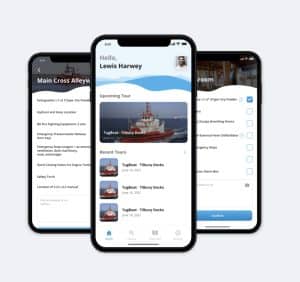
As a seafarer based in Essex, Conner brings more than 17 years of knowledge from working in marine salvage and a further 23 years at sea from container ships to harbour tugs, he came up with a solution. Safety Motivator is the product of real-world experience and responds to the practical difficulties in the delivery and management of safety information onboard. The platform provides vessel operators with a simplified digital environment through which familiarisation can be delivered, managed and recorded straight from the mobile device.
By migrating towards digitalisation and automation, operators can tighten compliance while ensuring important safety information that is more accessible.
“I’ve witnessed too many incidents that could have been avoided. The objective is not to replace the professional judgement of masters, safety officers or experienced crew, nor to suggest that technology alone creates a safe vessel. It is about providing those responsible for safety with a better tool. The platform gives instant access to information straight from the palm of your hand”.
Conner – Founder, Safety Motivator
From Compliance to Safety Culture
Effective familiarisation sits at the intersection between regulatory compliance, operational efficiency and human safety, not simply because a regulator requires it. The objective is to ensure that personnel know how to respond. Where is the nearest escape route? What does a particular alarm mean? Where should they muster? What equipment is available? What hazards are specific to this vessel? These concerns become elevated in an emergency. Full digitalisation can never eliminate maritime risk. But it can ensure that key information is provided consistently, that completion of safety familiarisation can be better audited, and that personnel and operators are able to optimise visibility.
A Changing Maritime Environment
Compliance in regulatory requirements continue to change. The International Maritime Organisation is preparing the workforce for another major transition as alternative fuels and new vessel technologies create new competency and training requirements for seafarers. The direction of travel is clear: the vessels, technologies and risks encountered by maritime personnel are changing, and the systems used to prepare people to work safely onboard must evolve with them.
Safety, Simplified
Safety Motivator offers a pragmatic response: a platform designed from experience at sea and around the realities faced by the people who operate, maintain and work onboard vessels.
Moving familiarisation from the clipboard towards a structured digital environment is about ensuring that essential safety information reaches the right person, on the right vessel, at the right time.
When an emergency occurs at sea, familiarisation stops being paperwork. Compliance of law is visible and not disputable.
It becomes preparedness.
For more information or to book a demo, visit www.safetymotivator.com